
AWS Curriculum, 2026 Edition
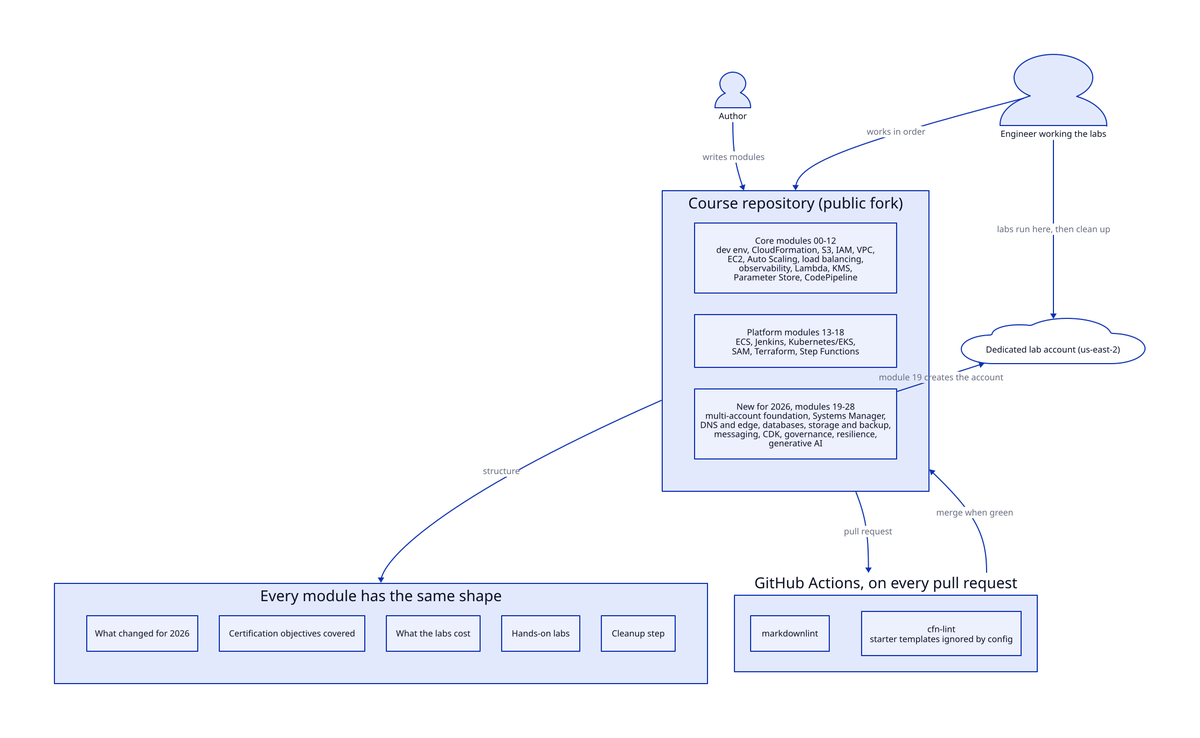
Modules are written and linted through pull requests; every module follows the same structure, and the labs run in a dedicated account that one of the modules creates.
The Challenge
The open-source engineer-onboarding course this work is based on had gone quiet: its newest content was several years old, and it still taught services, defaults and console flows that AWS has since changed or retired. Its labs also had no cost guidance and no consistent cleanup, which is how a training account quietly accumulates a bill.
The goal was a curriculum that is current, maps onto today's certification exams, and is honest about what each lab costs and how to tear it down.
The Solution
A public fork now carries a 2026 edition: 19 updated modules and 10 new ones, covering the foundations (CloudFormation, S3, IAM, VPCs, EC2, Auto Scaling, load balancing, observability, Lambda, KMS, Parameter Store and CodePipeline), the platform tier (ECS, Jenkins, Kubernetes on EKS, SAM, Terraform and Step Functions), and new material on multi-account foundations, Systems Manager, DNS and edge, databases, storage and backup, messaging and events, the CDK, governance and detection, resilience engineering and generative AI.
Every module states what changed for 2026, which certification objectives it covers, what its labs cost and how to clean up afterwards. Labs run in a dedicated lab account in a single region, created by the multi-account module that comes early in the sequence. Module writing is complete; the lab validation runs are in progress.
Implementation Details
The course is treated like a codebase rather than a pile of documents.
- Linting in CI: a GitHub Actions workflow runs markdownlint over the prose and cfn-lint over every CloudFormation template on each pull request, with deliberately incomplete starter templates excluded by configuration, so exercises stay broken on purpose without breaking the build.
- Written conventions: an authoring guide fixes the structure every module follows, so 29 modules written over time still read as one course.
- Cost and cleanup as content: each module carries its own cost note and a closing cleanup step, making the teardown part of the lesson instead of an afterthought.
- Exam-aligned sequence: modules are ordered in phases that follow the certification objectives, and the multi-account module comes early because the later labs depend on the account it creates.
- Current service behaviour: updated modules reflect current defaults and features rather than the versions taught previously, including managed Kubernetes access entries and pod identity, and CI running on current runtimes.